Synopsis
Government prepares to allocate commercial satellite spectrum. BSNL may gain an advantage due to lower regulatory charges. Private firms like Starlink and Jio Satellite will face higher levies. BSNL currently serves strategic users. It pays one percent of revenue as spectrum charges. Private players may pay four percent. BSNL also plans direct-to-device services for broader customers.

New Delhi: As the government prepares to allocate commercial satellite spectrum to private players such as Starlink, Eutelsat OneWeb and Jio Satellite, state-run Bharat Sanchar Nigam (BSNL) may have an edge, not only because it is already providing satcom services but also because of lower regulatory levies.
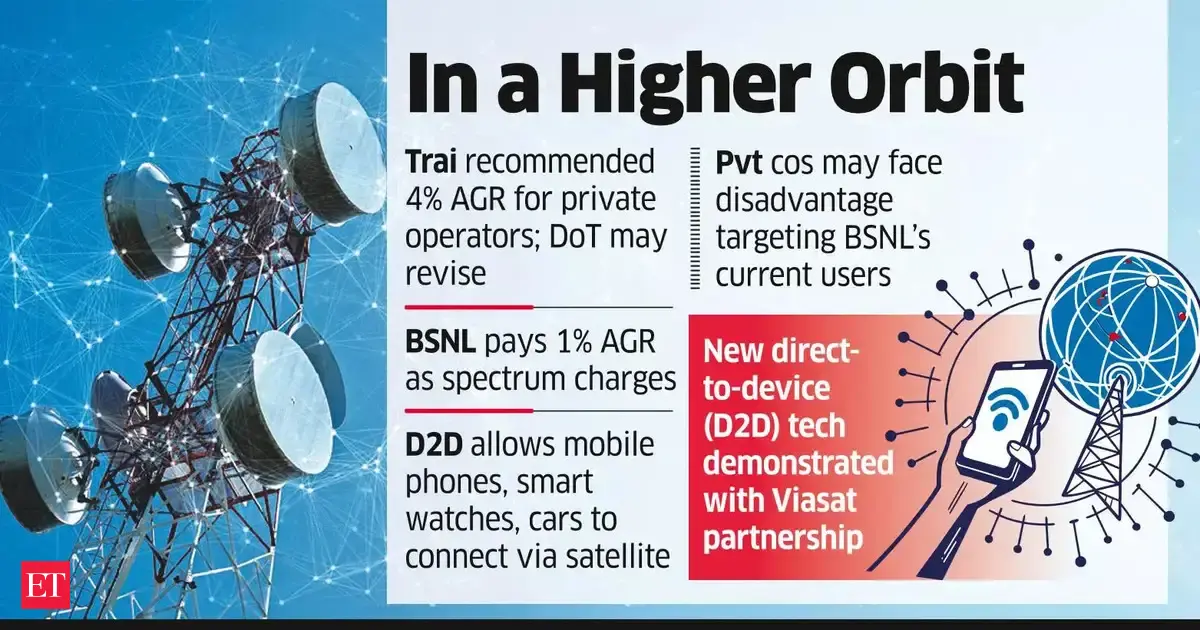
BSNL is offering satcom services primarily to strategic users, security agencies and government, and is paying 1% of adjusted gross revenue (AGR) as spectrum charges, according to officials. The Telecom Regulatory Authority of India (Trai) had recommended a 4% AGR as charges for private firms, which may be revised upwards as the Department of Telecommunications (DoT) has not accepted the pricing. BSNL, however, is likely to continue to pay 1% owing to the strategic requirements.
Therefore, even as private firms may plan to target the users currently served by BSNL, they may have a disadvantage due to the lower levies being paid by the state-run telco, said experts.
The government, however, is likely to charge different levies from BSNL for its planned direct-to-device service as it will be offered to a broader set of customers commercially.

Last year, satcom provider Viasat had demonstrated direct-to-device connectivity in partnership with BSNL during the India Mobile Congress. Two-way messaging and SoS messaging were demonstrated using a commercial Android smartphone enabled for non-terrestrial network connectivity. As per Viasat, the messages were sent roughly 36,000 km to one of its geostationary L-band satellites.
Direct-to-device connectivity is a new technology which allows everyday devices such as mobile phones, smart watches and cars to connect to both terrestrial and satellite coverage. It follows new global mobile 3GPP release 17 standards, which are currently being adopted by satellite operators, mobile network operators, handset and chipset manufacturers.
Elon Musk-owned Starlink is also building a constellation of direct-to-device satellites.
BSNL is currently providing satcom service under a special category of licence called GSPS (Sui Generis) licence. The DoT is working to allocate satellite spectrum to private firms. It has decided to refer back Trai recommendations on satcom pricing for clarifications. Once the regulator provides the clarifications, the DoT will finalise the pricing and other modalities to allocate spectrum administratively to all eligible firms.