General
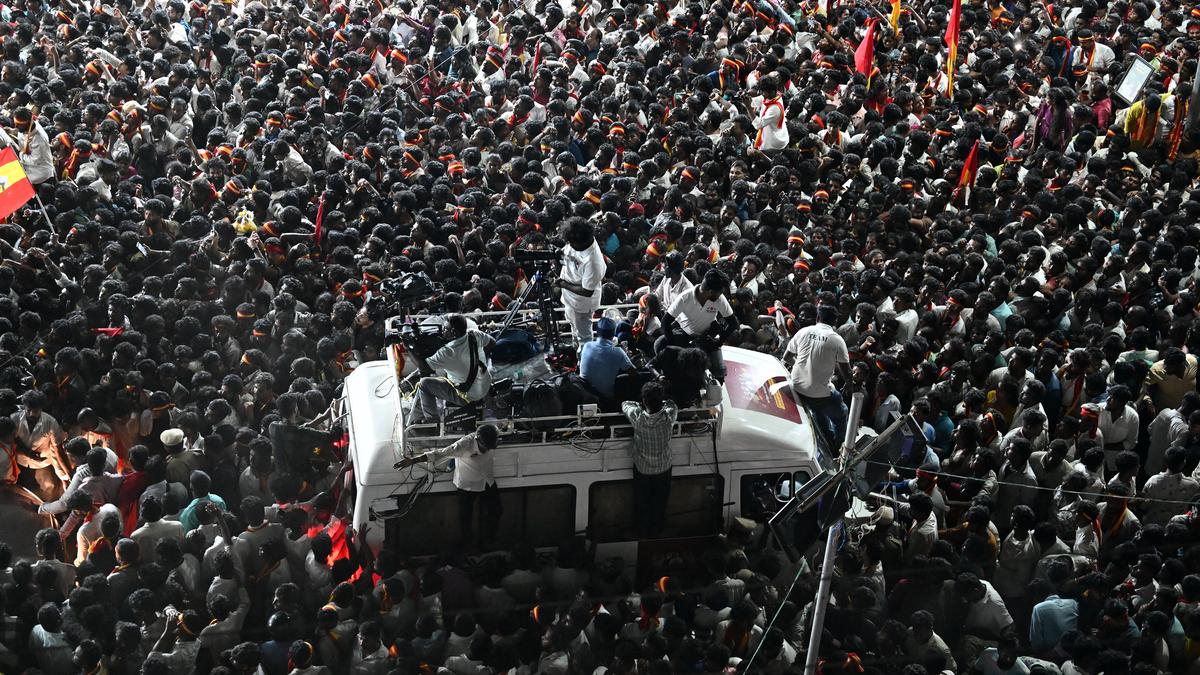
The recent tragedy at a political rally of actor-turned-politician Vijay, where a stampede claimed the lives of several of his supporters, should shake the conscience of any well-meaning individual. The dead were mostly fans — ordinary men and women who had thronged the event not merely for politics, but to catch a glimpse of their beloved star. That they perished in their devotion is a stark reminder of how perilous the cult of hero-worship can be.
In Tamil Nadu, the incident is neither unprecedented nor wholly unexpected. The State’s political history is entwined with cinema, with a lineage of actors and writers who have turned the fan’s gaze into a vote bank, and then into consolidated political power. The lines between reel and real life have been blurred for decades, with film scripts doubling up as political manifestos and larger-than-life cinematic personas re-enacted on the campaign trail. Vijay’s entry into politics is therefore less an anomaly than an almost natural continuation of this tradition.
However, the cult of the leader is not unique to Tamil Nadu, nor even to India. It is a feature of human societies across geographies and epochs. But in India, with its long history of reverence for individuals — from spiritual gurus to kings, from poets to film stars — the danger of confusing adulation with citizenship has always been acute.
Historical warnings
India’s freedom struggle was not just against colonialism, but against the feudal structures of thought that propped it up. Many of the leaders of that era recognised the peril of blind devotion to individuals. They knew from history that when loyalty is transferred from ideas to personalities, democracy weakens and authoritarianism strengthens.
B.R. Ambedkar, in his historic speech to the Constituent Assembly on November 25, 1949, offered perhaps the most searing warning: “The second thing we must do is to observe the caution which John Stuart Mill has given to all who are interested in the maintenance of democracy, namely, not ‘to lay their liberties at the feet of even a great man, or to trust him with power which enable him to subvert their institutions.’ … In India, Bhakti or what may be called the path of devotion or hero-worship, plays a part in its politics unequalled in magnitude by the part it plays in the politics of any other country in the world. Bhakti in religion may be a road to the salvation of the soul. But in politics, Bhakti or hero-worship is a sure road to degradation and to eventual dictatorship.”
Even earlier, in a 1943 lecture, Dr. Ambedkar lamented how journalism itself had surrendered to this culture of uncritical adulation, “To accept a hero and worship him has become its principal duty. Under it, news gives place to sensation, reasoned opinion to unreasoning passion…”
The good doctor was not alone. Bhagat Singh, in his famous essay Why I am an Atheist, criticised precisely this tendency to treat leaders as infallible, “You go against popular feelings; you criticise a hero, a great man who is generally believed to be above criticism. What happens? No one will answer your arguments in a rational way; rather you will be considered vainglorious. … Merciless criticism and independent thinking are the two necessary traits of revolutionary thinking. … As Mahatmaji is great, he is above criticism … This is not constructive thinking. We do not take a leap forward; we go many steps back.” For Bhagat Singh, unquestioned devotion was not merely a political weakness but a regression of thought itself.
M.N. Roy, too, reflecting on the reputation of the Chinese leader Chiang Kai-Shek in Men I Met, warned against both the making of gods and the disappointment that inevitably follows, “Therefore, the objective historian must not be carried away by propaganda, for, or against him. He was neither a god nor a devil. If he failed to be a god-like hero, the fault is not his, but of the interested propagandists who wanted him to do what they wished. He was not a democrat; how could he serve the cause of democracy? He did not betray anybody; illusions about him were cruelly destroyed, because they were illusions. The disillusioned, whoever they may be, must blame themselves for the bitter experience. Hero-worship, not the man, is the real culprit.” Roy’s words cut to the core of the matter: it is not the leader alone who is at fault, but the society that demands heroes, invests them with expectations, and then writhes in disillusionment when reality intrudes.
The post-independence cult
Independent India’s political history is dotted with examples of personality cults that often overrode institutional safeguards. During the time of Indira Gandhi, the Congress party had become almost synonymous with her persona. The slogan “Indira is India, India is Indira” encapsulated how thoroughly politics could collapse into personality. The Emergency of 1975 was a direct manifestation of the authoritarian potential of the cult of personality, evidenced by the swift return of Indira Gandhi to power after only a few years away from it.
In later decades, regional satraps — from N.T. Rama Rao in Andhra Pradesh and Bal Thackeray in Maharashtra to Lalu Prasad in Bihar — built their political fortunes not just on policy or ideology but on cult-like charisma. Their followers often saw them not as fallible leaders but as embodiments of hope, identity, or even divinity. In Tamil Nadu, this trend was perhaps the most theatrical, with MGR’s fans performing rituals, and even engaging in acts of self-harm at his death.
Today, the cult of Narendra Modi stands as the most striking national example. His image dominates campaigns, policies, and even institutions. Supporters frequently collapse the distinction between nation and leader, echoing the failings of the Indira era. The problem is not unique to the BJP but the scale of PM Modi’s personal cult is unprecedented in contemporary Indian politics.
Why humans worship
The question, then, is why human societies, even in the modern era of reason and information, continue to fall prey to hero-worship. Psychologists have argued that the phenomenon stems from our evolutionary wiring: in complex groups, rallying around a single leader simplifies decision-making, reduces uncertainty, and provides a sense of collective identity. Sociologists point out that in unequal societies, leaders often become projections of people’s own unrealised aspirations. A farmer in rural Tamil Nadu who struggles with powerlessness may see in Vijay a redeemer who carries the promise of recognition.
But the roots of this malaise stretch back further, into the history of religion itself. In the infancy of human thought, when knowledge of the natural world was meagre, explanations were sought not in reason but in myth. Figures in sacred history — prophets, saints, and incarnations — were invested with absolute moral and metaphysical authority. Blind faith, born of ignorance, hardened into tradition, and tradition ossified into intolerance. It is this reflex of unquestioning devotion that later migrated into politics and culture.
That is why, even today, artists who dare to subject religious figures to critique — whether M.F. Husain with his paintings of Hindu goddesses, or the cartoonists of Charlie Hebdo in their satirical takes on Islam — are met not with debate but with violence. The parties of God, across faiths, insist that their heroes must remain inviolable, and that offence to them is unforgivable.
The American revolutionary Thomas Paine saw this clearly more than two centuries ago. “Lay then the axe to the root,” he wrote, calling for an end to the deification of men and the enthronement of reason instead. Until that axe is swung against the tree of hero-worship, the cycle of adulation, betrayal, and disillusionment will repeat.
The costs of this phenomenon are borne not just by democracy but also by the people themselves. The stampede at Vijay’s rally is a tragic literalisation of the phrase crushed under the “weight of devotion”. But beyond such immediate tragedies, there are deeper consequences. Hero-worship erodes accountability: leaders become beyond question, their failures rationalised, their excesses forgiven. It breeds intolerance: criticism of the leader is seen as betrayal of the community or the nation. And it diminishes the citizen: instead of active participants in a democracy, people are reduced to passive spectators, awaiting cues from their chosen saviour.
Hero-worship also distorts policymaking. Rather than responding to collective needs through institutional mechanisms, policies become instruments of image-building. Welfare schemes are branded with leaders’ faces and national interest is subordinated to personal prestige.
Towards a politics of institutions
The antidote to hero-worship is not cynicism but maturity — the maturity to separate admiration from adulation, respect from surrender. Leaders can and should be admired for their vision, their achievements, and their service. But admiration must not curdle into devotion. The republic’s health depends on the vigilance of its citizens and the strength of its institutions. Citizens must reflect not only on the culture of film-star politics but also on the fragility of its democracy when fandom substitutes for citizenship. India must heed the warnings of its founding figures and reinvest in building institutions that command loyalty beyond the lifespan of individual leaders.
Ultimately, the lesson is as much about politics as it is about human society at large. Whether in religion, in nationalism, or in celebrity culture, the temptation to worship heroes is perennial. It offers the comfort of certainty and belonging. But the price is almost always the same: disempowerment, manipulation, and, in the worst cases, tragedy.