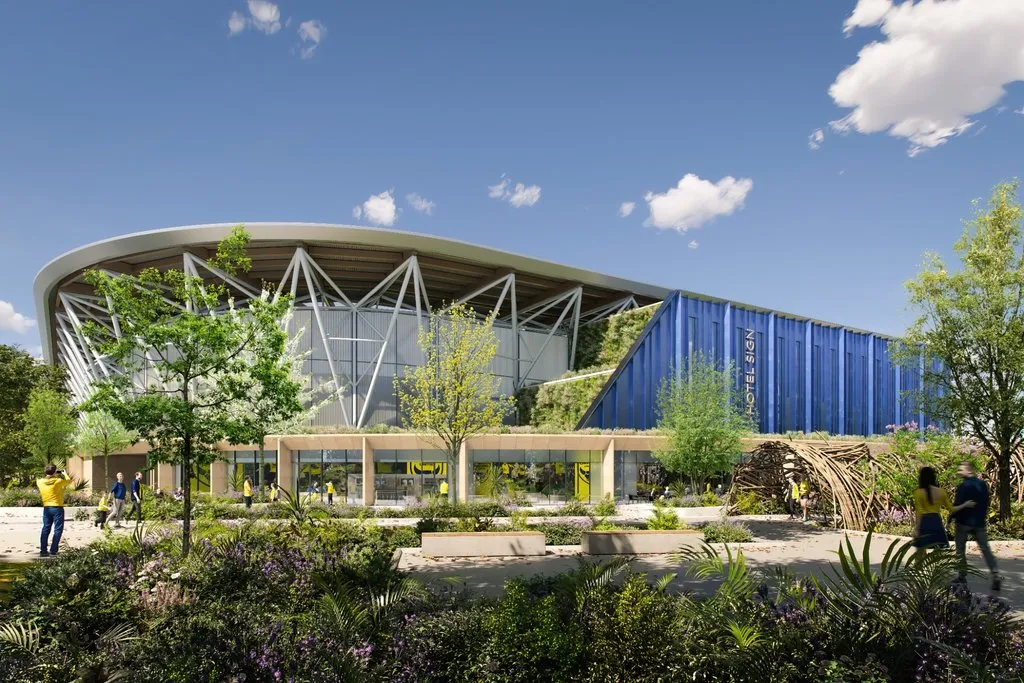
Cherwell District Council has approved plans for the UK’s first all-electric football stadium, giving Oxford United Football Club a permanent 16,000-capacity home.
The stadium will be built on a five-hectare site known as the Triangle, to the east of Frieze Way and south of the A34, between Oxford Parkway station and Kidlington roundabout.
The land is currently open grass with mature trees and lies within the Oxford Green Belt.
The location was selected following an assessment of more than 60 alternatives, with the Triangle identified as the only viable option meeting operational needs, transport access requirements and environmental criteria without posing flood or heritage risks.
Designed by AFL Architects, the venue will take the form of a steeply raked bowl enclosed on all sides.
The tallest stands will be on the west and north, accommodating hospitality, conferencing and a 180-bed hotel, while the roofline will taper down to the south-east to limit visual impact on nearby woodland and residential areas.
Materials will include a lightweight timber roof structure and lean steel frames to reduce embodied carbon.
Large glazed openings and landscaped terraces are planned to connect the public areas with surrounding green space.
The scheme will operate entirely on renewable energy, with 3,500 square metres of roof-mounted photovoltaic panels, an air-source heat pump and an energy-efficient building fabric.
These measures are projected to reduce annual CO₂ emissions by 80 per cent compared with a gas-fired equivalent.
The stadium is also designed to achieve a 20 per cent net gain in biodiversity through new tree planting, wildflower meadows, ponds, green roofs and rain gardens.
Ridge and Partners acted as project manager, design consultant and BREEAM adviser, also leading the site selection process, sustainability strategy and transport modelling.
The consultancy worked alongside Mott MacDonald on engineering services and Fabrik on landscape design.
The development will be supported by new transport infrastructure to encourage sustainable travel.
Nearly 450 cycle spaces will be provided, and the scheme includes dedicated fan shuttles from nearby Park and Ride facilities.
Pedestrian and cycle links will connect to neighbouring communities and public transport nodes, with enhanced bus and rail services planned.
The club forecasts that 90 per cent of match-day journeys could be made by sustainable modes.
The wider project will deliver a public plaza, wellness gardens, a 1,000-capacity conference centre, health services, hospitality and events space.
These facilities are intended to operate on non-match days, generating additional revenue and providing community amenities.
The council’s report noted that the development could unlock more than £130m of investment in the local economy and create substantial employment during construction and operation.
In recommending approval, planning officers acknowledged that the stadium’s construction in the Green Belt would constitute inappropriate development under national policy.
However, they concluded that the “very special circumstances” presented — including the club’s need for a permanent home, the site’s accessibility, the sustainable design, significant economic investment and community benefits — outweighed the identified harm.
The report also noted that the stadium’s form and landscaping would mitigate its visual impact and maintain openness where possible.
The committee agreed with the officer’s assessment, citing the scheme’s ability to secure Oxford United’s long-term future, its alignment with local transport and climate strategies, and its provision of new facilities for wider community use as decisive factors in granting consent.
The final committee vote was passed with 14 councillors in favour, three abstentions and one vote against approval, according to the BBC.
Source: Ridge & Partners press release and Cherwell District Council committee report