
General
Dulari Didi spoke about how we can’t run our household on just ₹66 a day. “We’re dying of starvation every day. It’s better to die once’ were her words.” At Tuta Dharna Sthal, a designated protest site in Chhattisgarh’s Naya Raipur, Savita Manikpuri tears up recalling her last conversation with Dulari Yadav.
Thirty-eight-year-old Manikpuri from Dudhawa village in Kanker district is among the hundreds cooks who have gathered at Tuta since December 29, 2025, on an indefinite strike in support of their demands. Key among these demands is a substantial increase in the monthly honorarium of ₹2,000 or what translates to ₹66 per day. Dulari from Bemetara, in her late 50s, was also among them until hours before she died on January 25.
On that day, Dulari took ill at the Tuta protest site, and was hospitalised, where she died during treatment. A day later, Rukmini Sinha, another cook from Balod district, died during treatment in Rajnandgaon. She too had joined the protest from January 20 to 23 and has returned after her health worsened.
While doctors say both the women who died had underlying health conditions, the protesters maintain that both the deaths happened due to exposure to the cold January weather. It has furthered their resolve to continue their stir, says Manikpuri, adding that they have gathered under the banner of the Chhattisgarh School Madhyanbhojan Rasoiya Sanyukta Sangh, an association which represents the 87,600-plus midday meal cooks.
The protest started with three key demands: “Raising the honorarium according to the collector dar [rates of wages] that’s roughly ₹350-400 per day, all the part time posts be changed to full time ones, and no cooks to be sacked if schools see a dip in the number of students,” says Ramrajya Kashyap, the State President of the association.
He says that depending on the district, anyone who gets work according to collector rates — an amount determined by the labour department — in that district draws anywhere between ₹9,000 to ₹13,000 a month and that was the minimum a person needed to sustain their families.
The association is now also demanding cancellation of a rioting FIR lodged against them on January 29, when they took out a rally. In addition, the cooks want a compensation of ₹10 lakh each for the two who died during the protests.
Daily duties
Manikpuri has two children, a husband, and a mother-in-law. Her older child has graduated from school, but Manikpuri is upset she hasn’t been able to earn enough to send her to college. Her younger child is in class 11 and she worries about his future.
“The situation in the village isn’t like in the city, where you can become an electrician or work in a shop and have work year-round,” she says. Her husband is a labourer, and work is seasonal. “There’ll be work when the crop has to be cut, or when there is construction work,” she says. He earns only about ₹250 a day.
Manikpuri wakes up at 4 a.m. and cooks for the whole family, packing food, then sending her son off to school. She’ll walk to her own school at about 9:30 a.m., about a kilometre from where she lives.
“A cook’s job isn’t just about preparing and serving food; we have many other tasks before and afterward,” she says. She and two other cooks unlock the school gates, open all the rooms and clean them. A cook is appointed for every 50 students, and Manikpuri’s school has 130. However, sometime, a single cook may have to prepare meals for more than the designated number, say the women on site.
Depending on the number of children in school that day, the cooks go to the women’s self-help-group-run stores to collect rations. They clean the rice and chop the vegetables, cook the food, and have it ready 10 minutes before lunch time at 1:30 p.m. They serve the children food and then clean up.
By the time she comes home, it is 3:30 p.m., and she must cook again. The children are hungry and her husband will be home soon.
A cooking gas cylinder costs around ₹1,200 rupees and there are days when Manikpuri has to resort to using a woodfired stove because the family cannot afford the cleaner fuel. Teeja Nag, a mother of five who is a widown and posted at a school in Dantewada district, says that in her school, the cooks use only firewood, and it’s part of their job to collect dead wood.
Some cooks, like Asful Nisha from Bagicha block of Jashpur district, say the duty chart also includes growing vegetables and maintaining the gardens within the school campus. This is an addition since the Mid-Day Meal (MDM) Scheme, under which most of these cook-helpers are engaged, was renamed Pradhan Mantri Poshan Shakti Nirman (PM-POSHAN) with a restructuring in 2021.
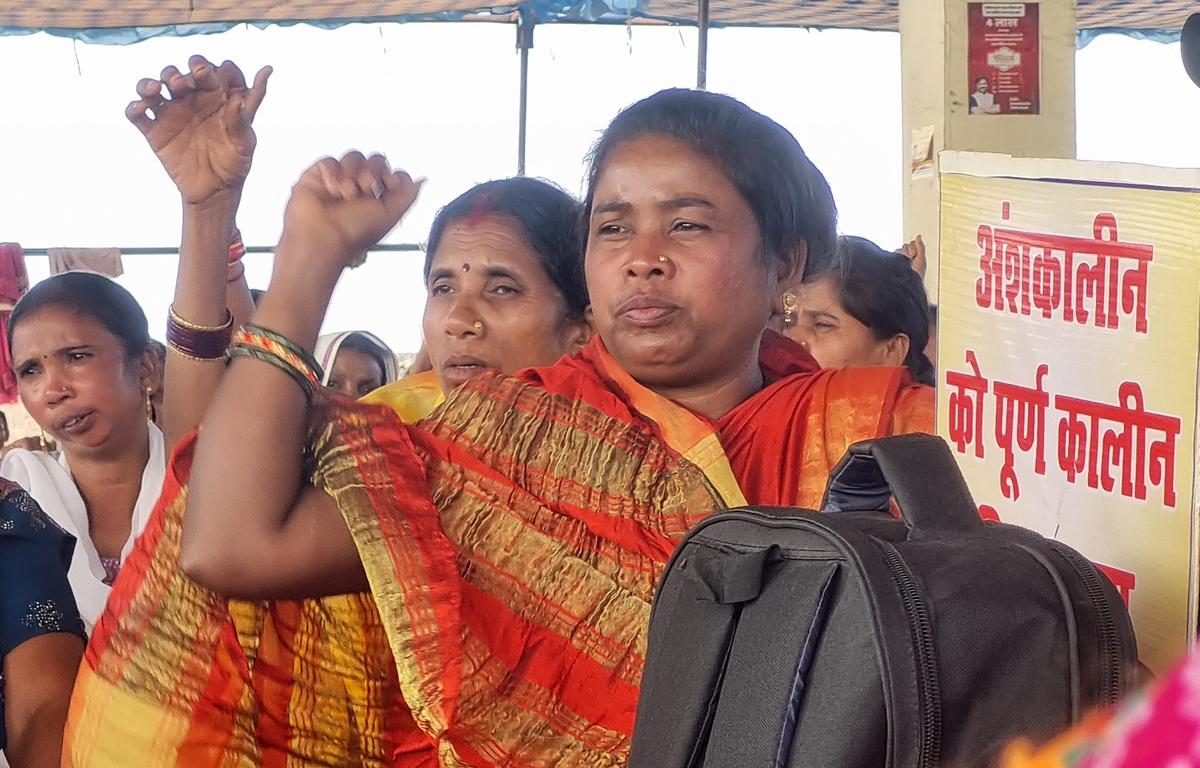
As the protest closes in on 50 days, the Chhattisgarh cooks stand firm in their demand for an honorarium according to the collector dar rates, roughly ₹350-400 per day, in comparison to the ₹2,000 per month they now get.
| Photo Credit:
Shubhomoy Sikdar
The PM-POSHAN scheme, rolled out for a five-year period from 2021–22 to 2025–26, provides one hot, cooked meal to students up to Class 8 in government and government-aided schools. It replaced the scheme, which had been in place since 1995 to promote universal primary education. Under PM-POSHAN, expenses are shared between the Centre and States in a 60:40 ratio, with the Union government also supplying foodgrains.
The duties for a cook are stretched on days when there is a sporting event or during elections, when they have to cook for those on polling duty. These extra hours come with no additional financial benefits.
Working in school has also brought forth tragic accounts: someone being asked to clean up before meeting her dying mother, someone hiring a replacement cook at ₹200 to attend her younger sister’s funeral.
Gender limitations
Around 95% of the cooks are women. Forty-six-year-old Dhansi Yadav, who has been employed as a cook in his village of Tatipara in Kondagaon district since 1996, is one of the few men. Since last year when his wife passed away, he has been juggling several responsibilities at home, looking after his three children.
Dhansi’s father too was a cook in the village school. He was employed at a daily wage of ₹15 per day when Chhattisgarh was a part of Madhya Pradesh. For his monthly honorarium to touch ₹1,000, Dhansi had to wait until 2011. That year the money began being credited directly into the cooks’ bank accounts instead of them receiving payments through the school teachers or the Panchayat. Since 2011, it has been hiked to ₹2,000 in phases. His eldest daughter was forced to drop out of college due to financial distress, he adds.
Many people take up the job because they don’t have a choice. Both Dhansi and Manikpuri needed to be close to their children. When she applied for the job, 40–50 people applied at the time, she says. “Many others were offered this job but declined, saying they had families and children, and couldn’t survive on such a low salary (₹1,000 in 2011),” she says.
But there was another reason they joined: “We took up government work with the belief that sooner or later the government would recognize us as salaried employees. It’s not like if we work for ₹15 on the first day, we will continue to work for that armount for the rest of our lives,” Manikpuri adds.
All the cooks are paid for 10 months a year; May and June are months of no work and no pay. In this gap, finding work under Mahatma Gandhi National Rural Employment Guarantee Scheme which would potentially bring in ₹268 every day for a cook is also not easy for most. First, they say there are very few opportunities and machines such as excavators are further shrinking the net. Even if there is a job, officials deny them work citing their names in school records.
Dhansi and Ramrajya have witnessed several rounds of protests since the 1990s. While this did lead to a revision of honorarium, they were never in sync with inflation and the realities of family employment.
“From ₹1,000 it became ₹1,200 after a protest. Then another protest took it to ₹1,500, and then another one to ₹1,800. The last major protest took it to ₹2,000,” Dhansi remembers. He says most protests lasted between 15 and 65 days.
The cooks understand that their strike means children go without their midday meals. In the poorer regions, families do not have the resources to pack lunch for them. Ramrajya acknowledges that with exams approaching, food and nutrition are critical, but the association fears that withdrawing or pausing the movement would set it back years.
“I met Chhattisgarh School Education Minister, Gajendra Yadav, on January 9 when he said that even without protests, he had issued an order to the department to increase the honorarium by 50%,” says Ramrajya, adding that the Bharatiya Janata Party had promised this in their manifesto for the 2023 Assembly polls. From the stage, he says into a microphone: “Irrespective of the party in power, our demands have remained unmet.” When he met the minister again on January 28, the hike was revised to 25%., he says.
The Hindu tried reaching out to Gajendra Yadav and Pardeshi Siddharth Komal, Secretary, School Education, but there was no reply to phone calls.
Lucknow-based Kailash Kashyap, the general secretary of the Rashtriya Rasoiya Sanyukta Sangharsh Morcha, a national association for cook-helpers, says that the Centre allows the States to increase the honorarium, and that States such as Tamil Nadu and Kerala provide significantly higher sums to cooks than Chhattisgarh or even his home State of Uttar Pradesh, where again ₹2,000 is the honorarium. The protesters at the Tuta site argue that Chhattisgarh, as a resource-rich State, can afford to pay more.
“I have been here for the past 31 years. Had they added even ₹100 per month every year, it would at least have been ₹3,100 today,” says Ramrajya.