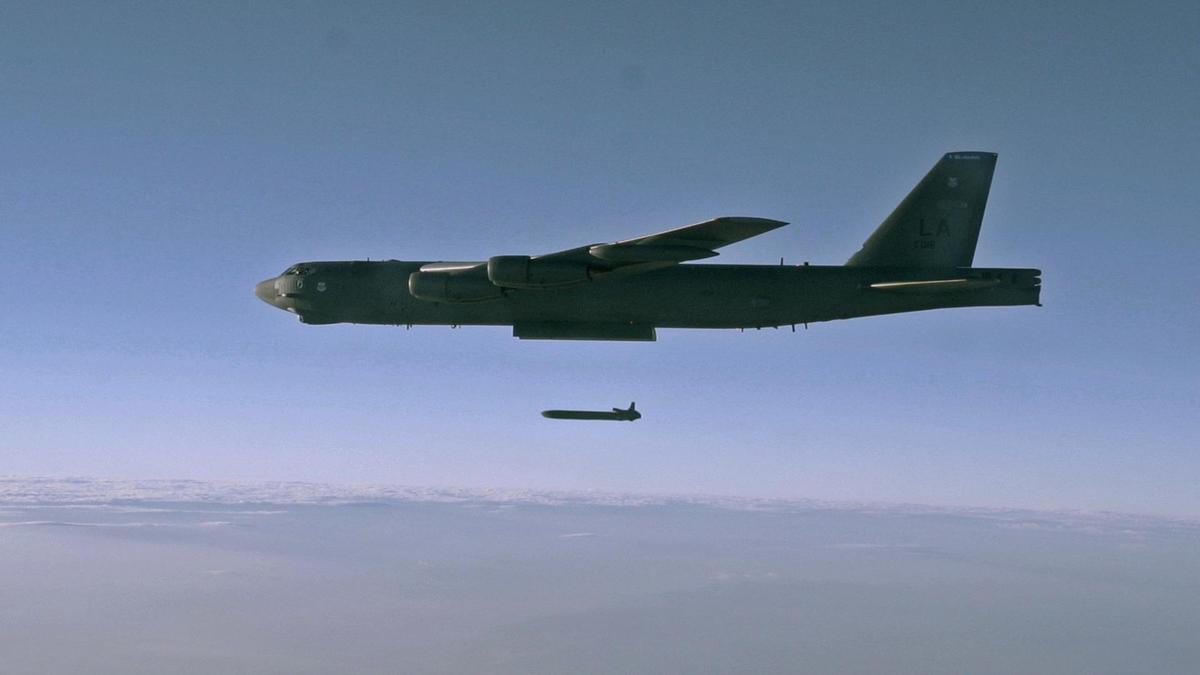

An unarmed AGM-86B Air-Launched Cruise Missile is released from a B-52H Stratofortress over the Utah Test and Training Range during a Nuclear Weapons System Evaluation Program sortie, 80miles west of Salt Lake City, Utah, U.S., September 22, 2014.
| Photo Credit:
US AIR FORCE
US President Donald Trump ordered
the U.S. military on Thursday to immediately resume testing
nuclear weapons after a gap of 33 years, minutes before
beginning a meeting with Chinese President Xi Jinping.
How many nuclear weapons tests have there been, why were
they stopped – and why would anyone start them again?
THE NUCLEAR AGE
The United States opened the nuclear era in July 1945 with
the test of a 20-kiloton atomic bomb at Alamogordo, New Mexico,
in July 1945, and then dropped atomic bombs on the Japanese
cities of Hiroshima and Nagasaki in August 1945 to force Japan
to surrender in World War Two.
The Soviet Union shocked the West by detonating its first
nuclear bomb just four years later, in August 1949.
In the five decades between 1945 and the 1996 Comprehensive
Nuclear Test-Ban Treaty (CTBT), over 2,000 nuclear tests were
carried out, 1,032 of them by the United States and 715 of them
by the Soviet Union, according to the United Nations.
Britain carried out 45 tests, France 210 and China 45.
Since the CTBT, 10 nuclear tests have taken place. India
conducted two in 1998, Pakistan also two in 1998, and North
Korea conducted tests in 2006, 2009, 2013, 2016 (twice) and
2017, according to the United Nations.
The United States last tested in 1992, China and France in
1996 and the Soviet Union in 1990. Russia, which inherited most
of the Soviet nuclear arsenal, has never done so.
Russia held nuclear drills last week and has tested a
nuclear-powered cruise missile and a nuclear-powered torpedo but
has not tested a nuclear warhead.
WHY WAS NUCLEAR TESTING ENDED?
Concern mounted about the impact of the tests – above
ground, underground and underwater – on human health and the
environment.
The impact of the West’s testing in the Pacific and of
Soviet testing in Kazakhstan and the Arctic was significant on
both the environment and the people. Activists say millions of
people in both the Pacific and Kazakhstan had their lands
contaminated by nuclear testing – and have faced health issues
for decades.
By limiting the Cold War bonanza of nuclear testing,
advocates said, tensions between Moscow and Washington could be
reduced.
The CTBT bans nuclear explosions by everyone, everywhere.
It was signed by Russia in 1996 and ratified in 2000. The United
States signed the treaty in 1996 but has not ratified it.
In 2023, President Vladimir Putin formally revoked Russia’s
ratification of the CTBT, bringing his country in line with the
United States.
WHY WOULD YOU TEST AGAIN?
To gather information – or to send a signal.
Tests provide evidence of what any new nuclear weapon will
do – and whether older weapons still work.
In 2020, the Washington Post reported that the
administration of U.S. president Donald Trump had discussed
whether or not to conduct a nuclear test.
Apart from providing technical data, such a test would be
seen in Russia and China as a deliberate assertion of U.S.
strategic power.
Putin has repeatedly warned that if the United States
resumed nuclear testing, Russia would too. Putin says a global
nuclear arms race is already underway.
WHAT ARE BIG POWERS DOING WITH THEIR NUCLEAR WEAPONS?
The exact number of warheads each country has are secret but
Russia has a total of about 5,459 warheads while the United
States has about 5,177, according to the Federation of American
Scientists. Those number include deployed, stockpiled and
retired warheads.
The Washington D.C.-based Arms Control Association says the
United States has a stockpile of 5,225 nuclear warheads and
Russia has 5,580.
Global nuclear warhead stockpiles peaked in 1986 at over
70,000 warheads, most in the Soviet Union and the United States,
but have since been reduced to about 12,000, most still in
Russia and the United States.
China is the third largest nuclear power with 600 warheads,
France has 290, the United Kingdom 225, India 180, Pakistan 170,
Israel 90 and North Korea 50, according to the Federation of
American Scientists.
Russia, the United States and China are all undertaking
major modernisations of their nuclear arsenals.
Published on October 30, 2025