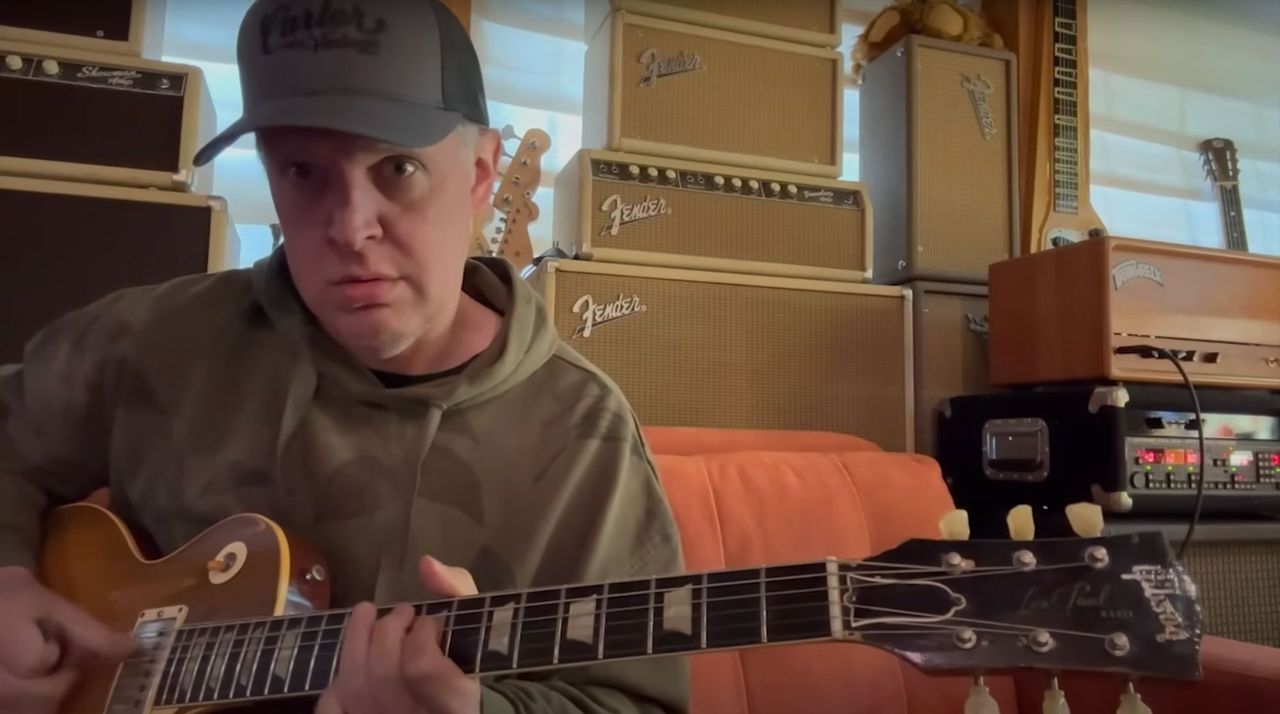
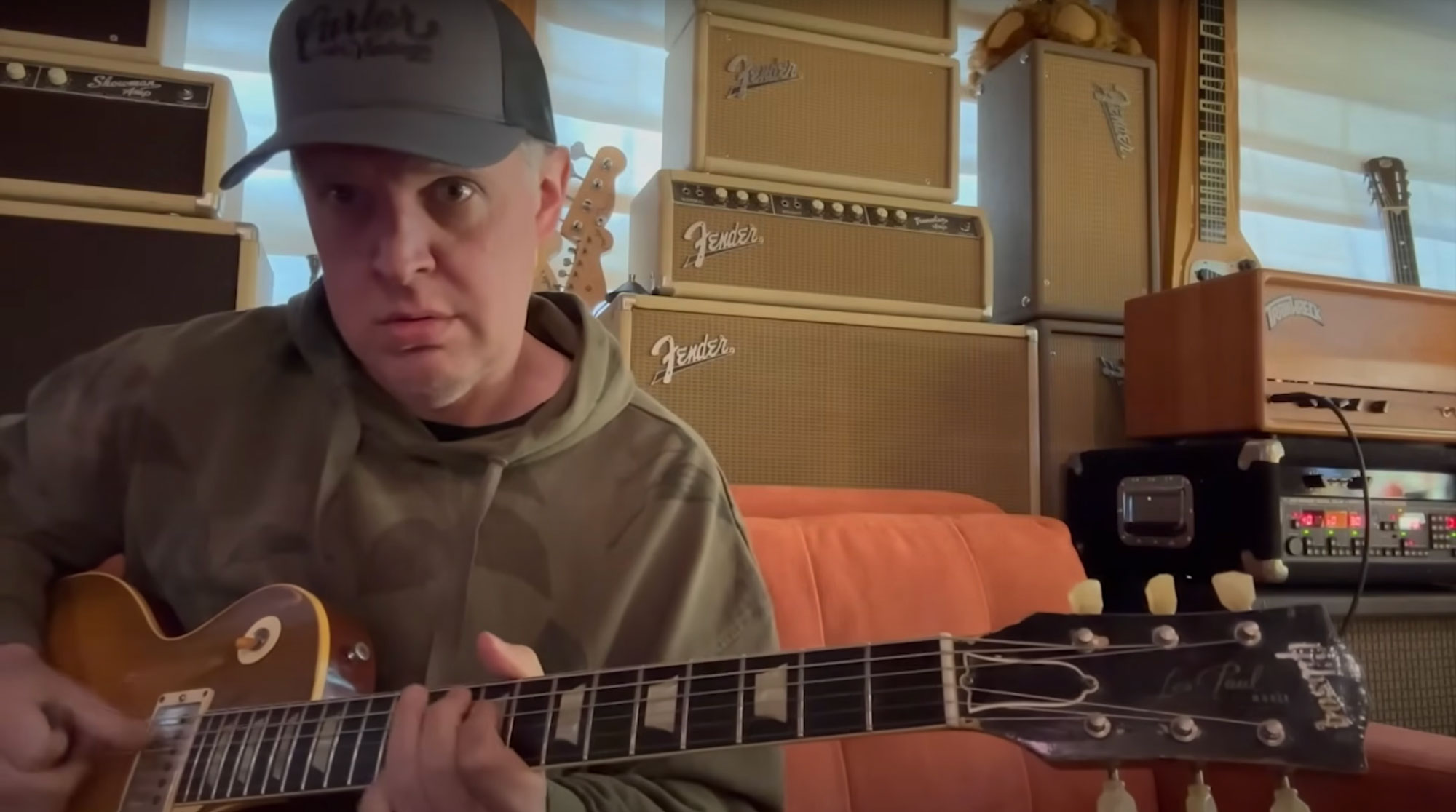
A big part of blues is playing over a “shuffle” groove – a triplet-driven swing-eighths feel with a backbeat (accents on beats 2 and 4) – at various tempos. There are many great shuffle-based tunes.
An example of a great slow shuffle is Jimmy Reed’s Bright Lights, Big City, and a great uptempo shuffle is Memphis Slim’s Steppin’ Out, covered brilliantly by John Mayall with Eric Clapton on the Bluesbreakers’ 1966 album.
One of my favorite medium-slow shuffles is Jeff Beck’s Rock My Plimsoul, which was featured on his debut album, Truth, and is based on the B.B. King blues classic Rock Me Baby.
Joe Bonamassa: How to play a shuffle! – YouTube
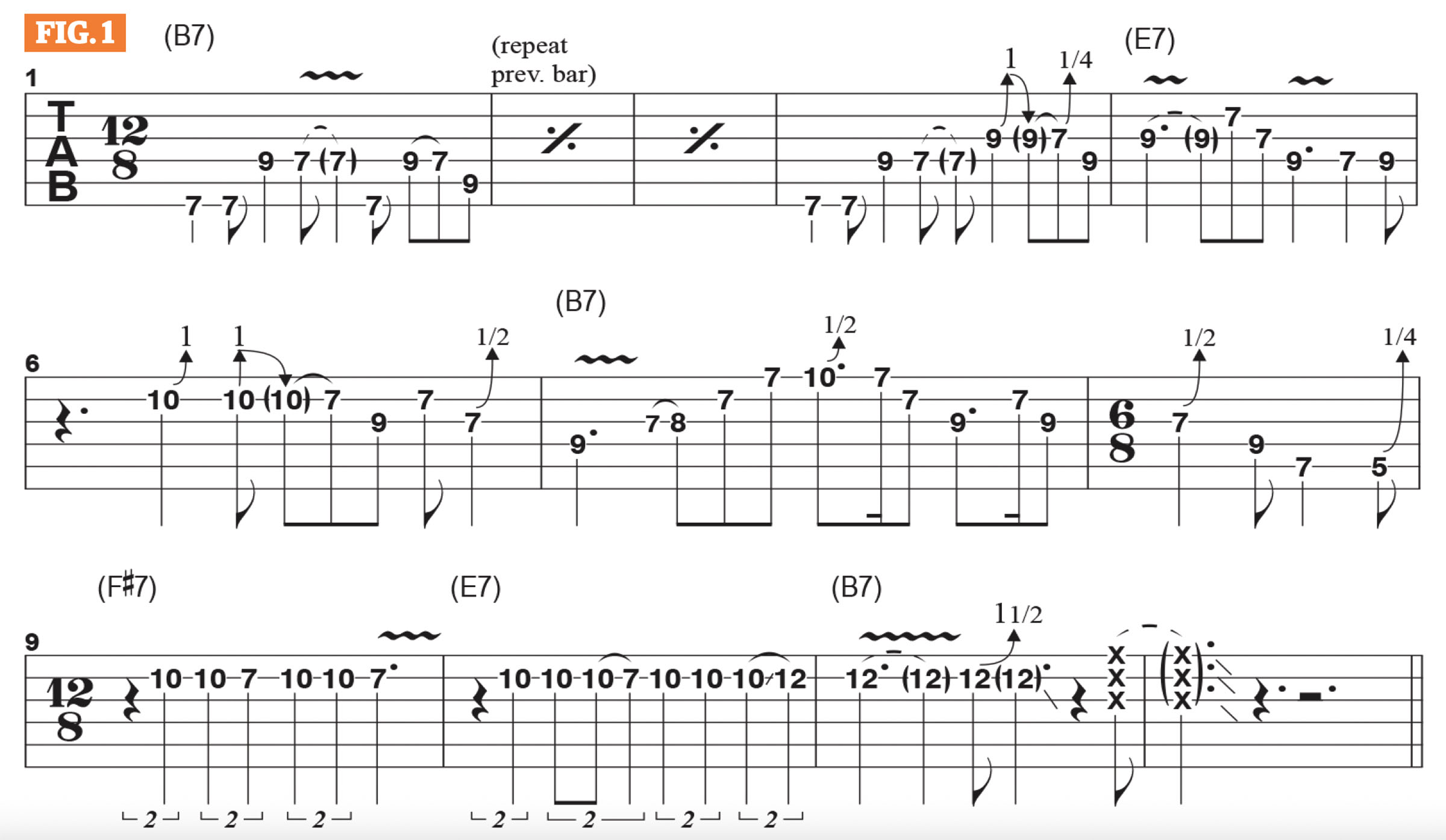
Played in the key of B, the tune’s main riff is similar to bar 1 of Figure 1, which is a simple, repetitive motif based on the B minor pentatonic scale (B, D, E, F#, A). In bar 3, I play a single-note phrase that sets up the change to the IV (four) chord, E7, in bars 5 and 6, with the riff in bar 6 leading back to the I (one) chord, B7, in bar 7.
In bars 9-12, I emulate what Beck played for his intro solo, alternating between the notes A and F# on the B string with a staccato (short, clipped) attack. And, like Jeff, I end the phrase in bars 11 and 12 with an aggressive slide down the top three strings.
When you’re playing a shuffle at this moderate tempo, you can approach it in a similar way to a slow blues. Figure 2 is played in the style of B.B. King. I begin with a B minor pentatonic-based phrase, bending D, the minor, of “flatted,” 3rd (b3) up a whole step to the 4th, E, release the bend then hammer on from D to the major 3rd, D#, followed by a barre across the top two strings at the 7th fret.
In bar 2, I switch to B major pentatonic (B, C#, D#, F#, G#) and then back to B minor pentatonic, shifting up to 10th position in bar 3. At the end of this bar, I shift up to 12th position and play another B major pentatonic phrase.
Alternating between parallel minor and major pentatonic scales in this way is a staple of blues melody making and can be heard in the playing of all our favorite blues and blues-rock guitarists.
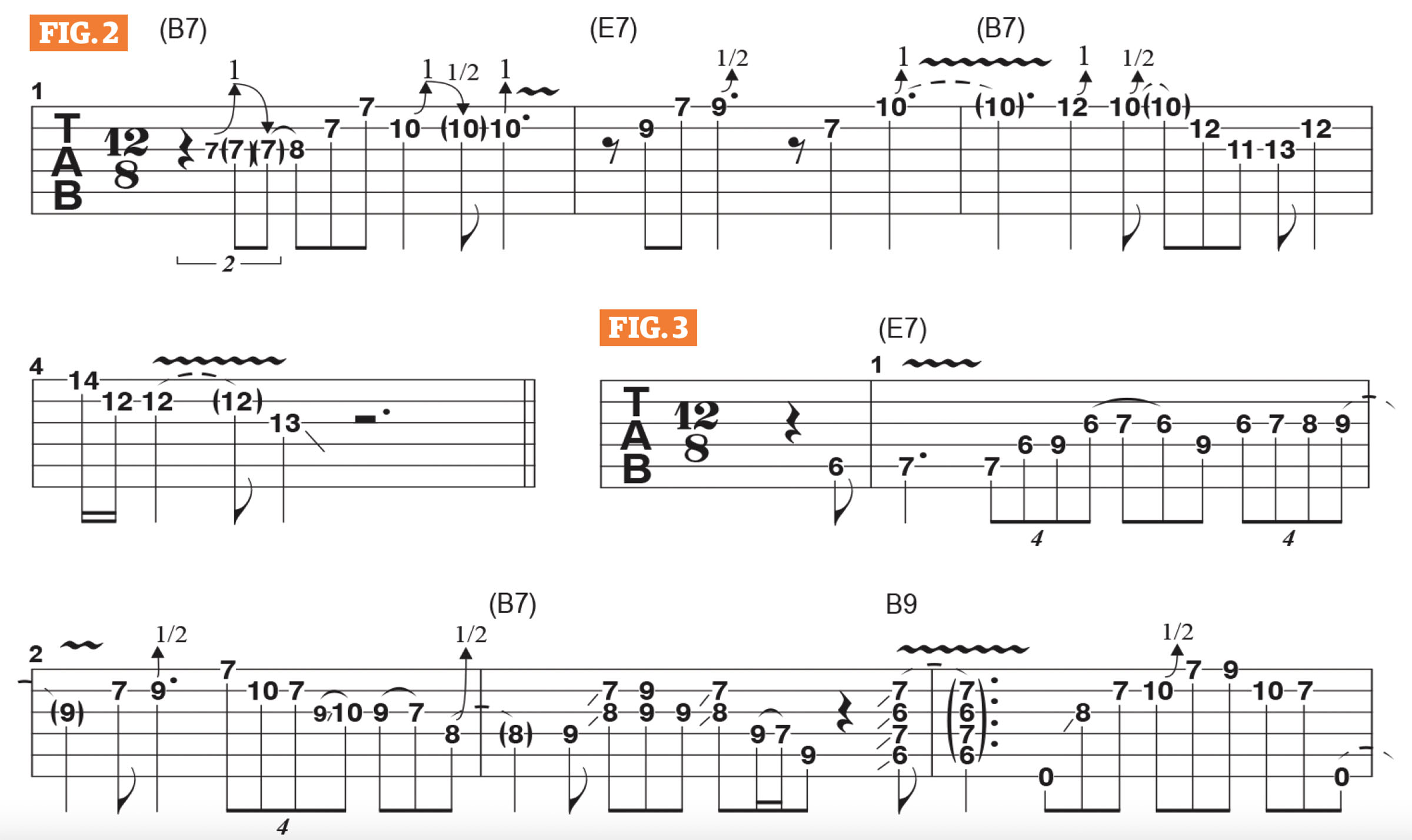
A great benefit of a slower tempo is that it gives you a lot more time to think about what you’re playing and express yourself. In Figure 3, I start on the IV chord, E7, and play simple licks that lay far back in the groove. In bars 3 and 4, I return to the I chord, B7, and play double-stops of D# and F#, and E and G#, referencing B7 and E7, respectively.
Bar 5 is played over the V (five) chord, F#7, and in bar 6 I return to the IV, E7, with lines based on B minor pentatonic. Notice that my phrasing is very “free” here.
One thing I like to do when playing in the key of B is utilize my open B string. For example, I can hammer-on from A to B on the D string while simultaneously plucking the open B note, using hybrid picking.
This is a great sound and one I associate with a British approach, though you will also hear the liberal use of open strings in the playing of the great Billy Gibbons of ZZ Top.
- Joe Bonamassa’s new album, Breakthrough, is out now via J&R Adventures.
- This article first appeared in Guitar World. Subscribe and save.