General

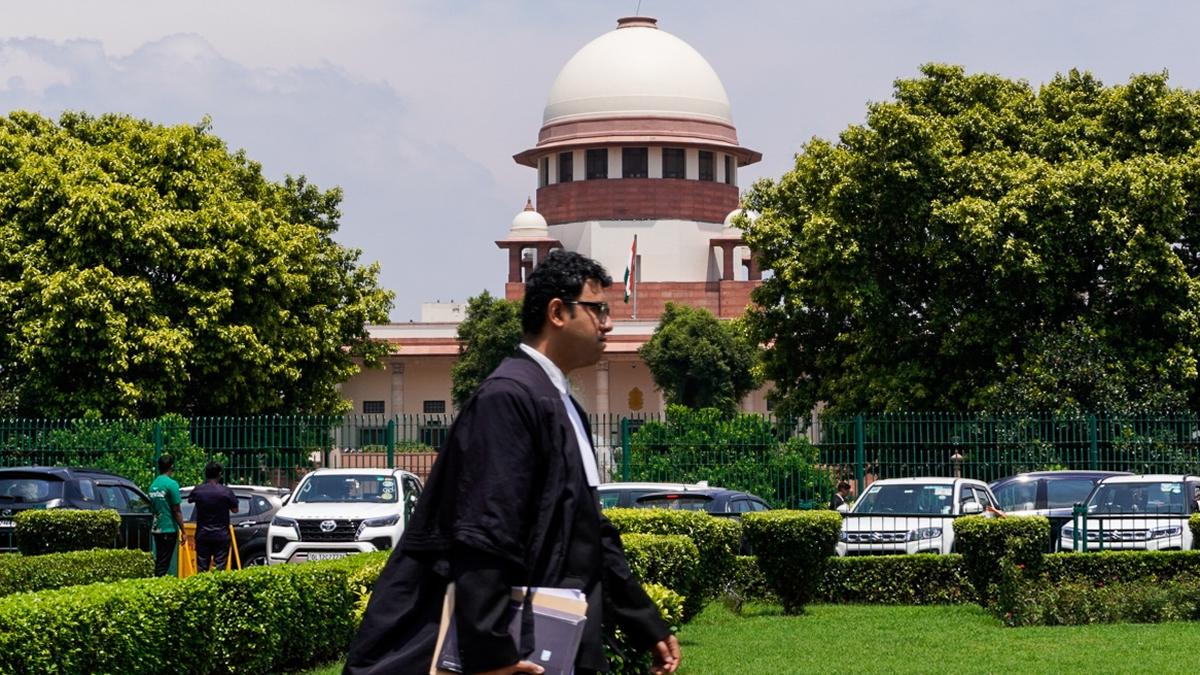
The Supreme Court on January 6, 2021 agreed to examine certain new and controversial laws of States like Uttar Pradesh and Uttarakhand regulating religious conversions due to interfaith marriages. File.
| Photo Credit: The Hindu
The Supreme Court on Tuesday asked a petitioner seeking a complete ban on “deceitful” religious conversions who exactly gets to decide if an inter-faith marriage is a fraud or not.
The Chief Justice of India B.R. Gavai agreed with senior advocate C.U. Singh, appearing for an NGO questioning the validity of increasingly stringent anti-religious conversion laws across 10 States, that the court sits to examine the constitutionality of laws, and not to make laws.
Petitioner-advocate Ashwini Upadhyay said his petition was against religious conversion through allurement and duplicity.
Mr. Upadhyay argued that one has the right to propagate religion under Article 25 of the Constitution, but not to convert through fraud or force.
Also read: Explained | What are the existing laws on religious conversions?
Highlighting the risk his plea posed to the freedom of conscience enshrined in the Constitution, Chief Justice Gavai pointedly asked, “but who would find out that a religious conversion was deceitful or not?”
Mr. Singh, appearing in the case along with senior advocate Indira Jaising and advocate Vrinda Grover, said that States, including including Uttar Pradesh, Himachal Pradesh, Madhya Pradesh, Uttarakhand, Gujarat, Chhattisgarh, Haryana, Jharkhand, and Karnataka have enacted copy cat ‘Freedom of Religion’ Acts one after the other, with Rajasthan recently coming up with one.
“The batch of laws are characterised as Freedom of Religion Acts, but they contain everything but freedom. They are virtually anti-conversion laws,” Mr. Singh submitted.
He sought a stay of these laws, which were getting more and more strident as courts grant bail and bring relief to persons accused and arrested under them.
The court scheduled the case after six weeks to consider the question of stay of the implementation of the Acts.
Mr. Singh said recent amendments made in these Acts empower third parties to file criminal complaints against couples who enter into inter-faith marriage. The punishment under these laws include a “minimum 20-year sentence or a maximum of life imprisonment”. The bail conditions are on par with the draconian Unlawful Activities (Prevention) Act. The burden of proof was on the convert to prove that he or she was not forced or “allured” to change faith, the senior counsel argued.
“For anybody who marries inter-faith, bail becomes impossible. These are Constitutional challenges… It is not just marriages but any normal church observances or festivals, mobs may come…” Mr. Singh submitted.
Additional Solicitor General K.M. Nataraj said the case was coming up for hearing after three years, “and suddenly they [the petitioners] are asking for stay?”

In 2023, while hearing the case, the apex court had refused to refer to the Law Commission of India the question whether “forcible conversion” should be made a separate offence relating to religion under the Indian Penal Code.
The government had even opposed the locus standi of the NGO, Citizens for Justice and Peace, represented by Mr. Singh, to move the apex court against these laws.
Mr. Singh had, however, argued that these laws amounted to undue interference in a person’s right of choice of faith and life partner. He said each law was used by the other as a “building block” to make a more “virulent” law for itself.
The petitions have argued that these laws have a “chilling effect” on the right to profess and propagate one’s religion, enshrined in Article 25 of the Constitution.
Published – September 16, 2025 04:34 pm IST