General
Last Updated:
The document contains several strikingly unconventional elements, particularly its soft-pedalling on Russia and a noticeable downgrade in the rhetorical priority given to India

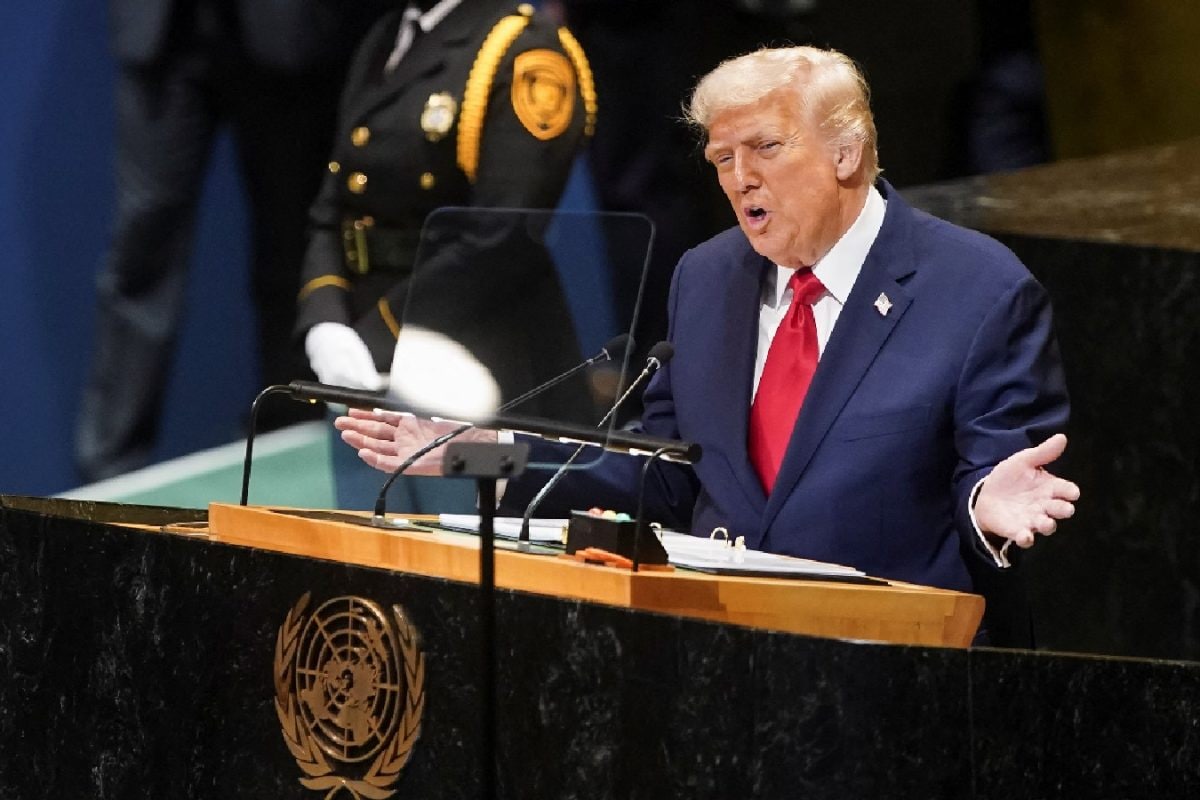
The document generated controversy by repeating President Trump’s assertion that he “negotiated peace between… Pakistan and India” following the May 2025 military confrontation. File pic/Reuters
The release of President Donald Trump’s National Security Strategy (NSS) for 2025 has provided a blunt blueprint for the administration’s foreign policy, confirming an expected sharp divergence from previous US approaches, particularly regarding Europe and the Indo-Pacific.
As noted by geostrategist Brahma Chellaney on X, the document contains several strikingly unconventional elements, particularly its soft-pedalling on Russia and a noticeable downgrade in the rhetorical priority given to India.
General Recommended Stories
Russia and Ukraine: Seeking an ‘Expeditious Cessation’
The strategy makes the resolution of the Russia-Ukraine war a declared “core interest” of the United States. However, the document’s language regarding Moscow is notably tempered compared to its stance on traditional allies. The NSS pledges to “negotiate an expeditious cessation of hostilities in Ukraine” and to “reestablish strategic stability with Russia.”
This framing prioritises immediate conflict resolution and stability over the complete restoration of Ukraine’s borders or a comprehensive condemnation of Russian actions. The strategy’s primary focus in this theatre appears to be limiting the conflict’s cost and enabling a pivot toward great power competition with China.
Europe: An ‘Unusually Blunt Indictment’
In sharp contrast to its treatment of Russia, the NSS offers an unusually caustic critique of European leadership, as highlighted by Chellaney. The document asserts that European leaders “hold unrealistic expectations for the [Ukraine] war” while being “perched in unstable minority governments, many of which trample on basic principles of democracy to suppress opposition.”
This language is interpreted as a clear push for European allies to assume greater responsibility for their own defence, echoing the “America First” principle by suggesting that American resources will be reallocated away from what the administration views as an overly dependent European security structure.
India: Downgraded Salience and A Claim of Peace
The strategy shows a clear shift in Washington’s articulation of its partnership with India. The 2017 NSS, as Chellaney noted, had accorded India “pride of place” in the Indo-Pacific strategy, explicitly welcoming “India’s emergence as a leading global power and stronger strategic and defense partner.” The latest document noticeably tempers this language, confining itself to stating that the US “must continue to improve commercial (and other) relations with India to encourage New Delhi to contribute to Indo-Pacific security, including through the ‘Quad’.” The mention of the Quad, a cornerstone of Indo-Pacific security cooperation, is strikingly brief, suggesting a reduced strategic emphasis compared to the sweeping declarations of the past.
Furthermore, the document generated controversy by repeating President Trump’s assertion that he “negotiated peace between… Pakistan and India” following the May 2025 military confrontation, a claim New Delhi has consistently and firmly rejected, maintaining that it resolved the conflict independently.
Pakistan: The Striking Omission
Perhaps the most dramatic shift in the new strategy involves Pakistan. The 2017 NSS was explicit and forceful, stating, “We will press Pakistan to intensify its counterterrorism efforts… The United States will also encourage Pakistan to continue demonstrating that it is a responsible steward of its nuclear assets.” The 2025 document, however, completely omits any critical reference to Pakistan, removing the explicit demands for counterterrorism action and responsible nuclear stewardship.
This silence signals a significant recalibration of US policy towards Islamabad, moving away from public criticism and conditioning of the relationship, a change likely welcomed in Pakistan but viewed with concern by India.
Overall, the 2025 NSS clearly signals a strategic shift focused on narrowly defined American interests, reduced entanglement in long-standing European conflicts, and a more transactional, commercially focused relationship with key Asian partners like India.
 Click here to add News18 as your preferred news source on Google.
First Published:
December 06, 2025, 16:31 IST
News world Trump’s 2025 NSS Redraws The Map: Russia Gets A Handshake, Europe A Lecture, India A Line
Disclaimer: Comments reflect users’ views, not News18’s. Please keep discussions respectful and constructive. Abusive, defamatory, or illegal comments will be removed. News18 may disable any comment at its discretion. By posting, you agree to our Terms of Use and Privacy Policy.
Read More