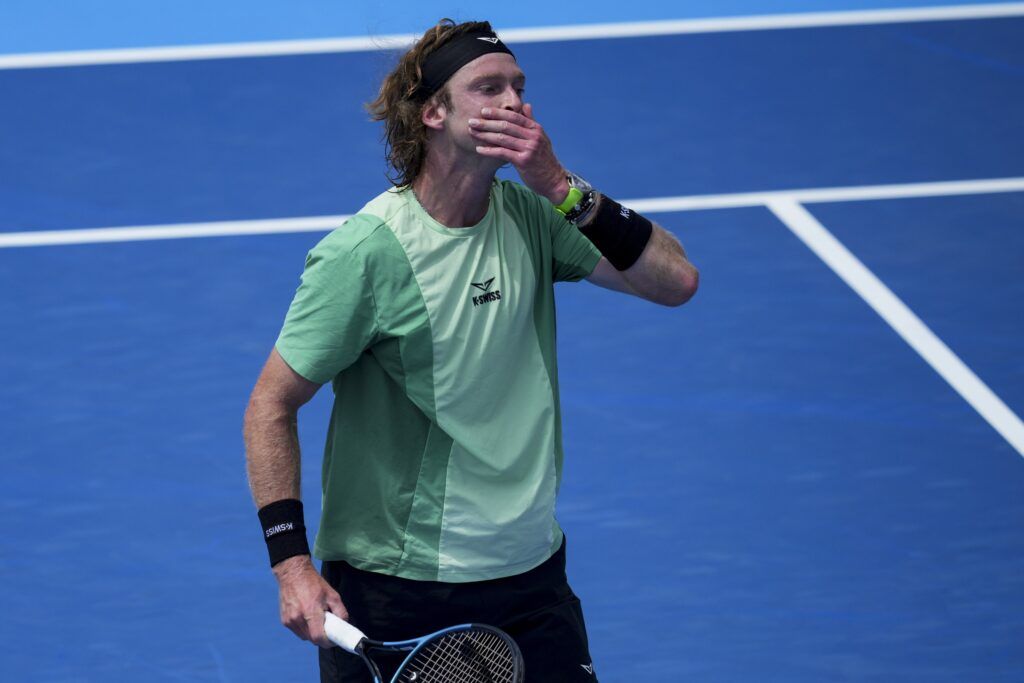
Andrey Rublev fell narrowly to Carlos Alcaraz in the Cincinnati Open quarterfinals, but the match became memorable for reasons beyond just the scoreline. While both players delivered an intense three-set battle in sweltering conditions, a brief but fascinating exchange between Rublev and chair umpire Mohamed Lahyani about the serve clock rule highlighted the challenges players face managing time between points in extreme heat.
How Did Andrey Rublev’s Serve Clock Discussion With Mohamed Lahyani Unfold During the Cincinnati Loss?
The incident took place in the first set with Alcaraz leading 3-2. Rublev complained to Lahyani that constantly reaching for his towel after almost every point amid the brutal heat left him scrambling to get set under the serve clock rule.
“I was taking towel after every point, and I was arriving in a short position, when it was 20 seconds. I was serving and to refer 20 seconds. You didn’t take the towel, take the bottle and straight away go and then I referred 20 seconds. All the rest, when I was taking the towel, I was around, it was 10 seconds again,” Rublev explained to the umpire.
The ATP’s serve clock rule, also known as the shot clock, allows 25 seconds between points. Since the clock takes about three seconds to start, players effectively have roughly 28 seconds to resume play. Exceeding this timeframe can result in a time violation, and repeated violations lead to point penalties.
Mohamed Lahyani becomes the first umpire ever to offer a satisfactory answer to a complaining Rublev
byu/Large_banana_hammock intennis
Lahyani, remaining calm throughout the discussion, offered practical advice. He suggested that Rublev stay near the baseline instead of walking the full length of the court, a strategy that could save nearly 10 seconds for preparation.
“But you have to short the preparation. What I can suggest to you, now you did. Don’t go the whole way. Stay at the baseline, you saved 10 seconds. You always do that Andrey, you have four seconds you are ready,” Lahyani responded.
The experienced umpire also reminded Rublev that the three-second delay before the serve clock begins operates automatically and isn’t under his control. Despite the concern, Lahyani noted that Rublev was managing the timing well and staying within the required limits.
“The three second off is automatic, I don’t control that Andrey. It’s automatically. But you are doing well, you didn’t go over anything. Always on time. If I see you go over, close, I will tell you. Because I know, the heat condition, if it’s long rally, I consider that as well. Okay just stay at the baseline, you will save time,” Lahyani added.
How Did Carlos Alcaraz Extend His Winning Streak After the Cincinnati Win Over Rublev?
Once the serve clock discussion concluded, the match resumed with Alcaraz maintaining his advantage to take the first set 6-3. However, Rublev showed his fighting spirit in the second set, claiming it 6-4 and forcing a decisive third set.
Both players battled intensely in the final set, but Alcaraz ultimately prevailed 7-5, extending his winning streak to 15 matches and securing his spot in the Masters 1000 semifinals. The victory also improved his head-to-head record against Rublev to 4-1.
Alcaraz, who leads the tour with 52 wins and five titles in 2025, will face World No. 3 Alexander Zverev in the semifinals. The Spaniard continues his impressive form as he builds momentum heading into the final stages of the tournament.